PHASE 1
Strategic Positioning
Define what makes each residence the clear choice in its local market.

Suites Filled
Return on Marketing
Percentage-Point Occupancy Lift per Residence
Residences in BC and Alberta
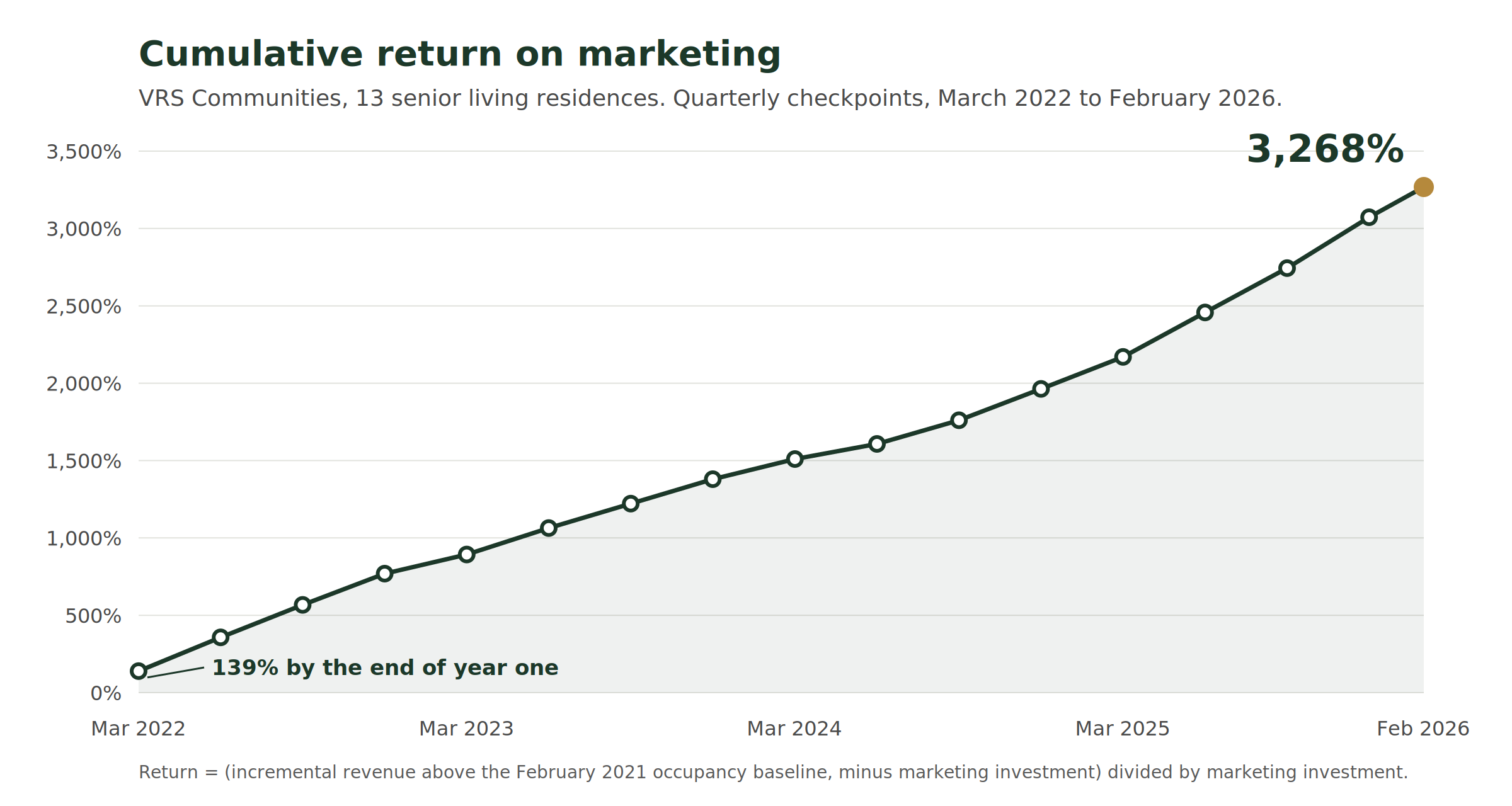
Wisdom First Marketing has worked with VRS Communities, a non-profit senior living operator, since February 2021. Across 13 independent and assisted living residences in British Columbia and Alberta, the partnership filled 275 suites, net of every resident who moved out. Average occupancy increased by 38.6 percentage points per residence, and marketing returned 3,268%.
VRS Communities is a Vancouver-based charitable non-profit that has provided housing in British Columbia since 1972. Its senior living residences offer independent living for middle-income seniors.
When the partnership began in February 2021, senior living was coming out of COVID-19, and move-ins had slowed across the sector. VRS relied on traditional, offline marketing. Families start their search online, so residences with little digital presence were missing from the shortlist before the first call. VRS also had no way to see which efforts produced inquiries, tours or move-ins.
The bigger challenge was churn. Every residence loses residents each year as their health changes or they move to a higher level of care. The more suites a portfolio has, the more move-outs it sees in a normal year. A portfolio of VRS's size needs a steady flow of move-ins just to hold occupancy level, before it can grow. Marketing had to run constantly, in 13 local markets, all year.
We built one system for the whole portfolio and tuned it for each residence's local market. It had two jobs: build trust with families before they ever called, and make sure VRS appeared everywhere families looked during their search. That system is the Trust Funnel. It runs in five phases, and each phase unlocks the next.
PHASE 1
Define what makes each residence the clear choice in its local market.
PHASE 2
Own local search, the map pack, and AI answers in each town.
PHASE 3
Show real life inside the residences, at high frequency.
PHASE 4
Reach families 12 to 18 months before a move.
PHASE 5
Respond in minutes and follow up until each family decides.
Google Ads captured families already searching for senior living, independent living and assisted living in each residence's town.
Meta Ads built local brand awareness and generated qualified leads through the Home Field structure, at $50 to $70 per lead.
Connected TV put VRS residences on the streaming services families watch at home, in each local market, reinforcing what they saw on Meta.
Creative was refreshed continuously. Audiences see the same ads repeatedly, and new photos, videos and messages keep costs down and attention up.
For more on choosing the right success metrics, see our guide to lead quality versus lead volume in assisted living.
VRS filled 275 suites across 13 residences in British Columbia and Alberta, net of every resident who moved out. Average occupancy increased by 38.6 percentage points per residence. Marketing returned 3,268%.
The partnership is now in its sixth year.
Meta Ads
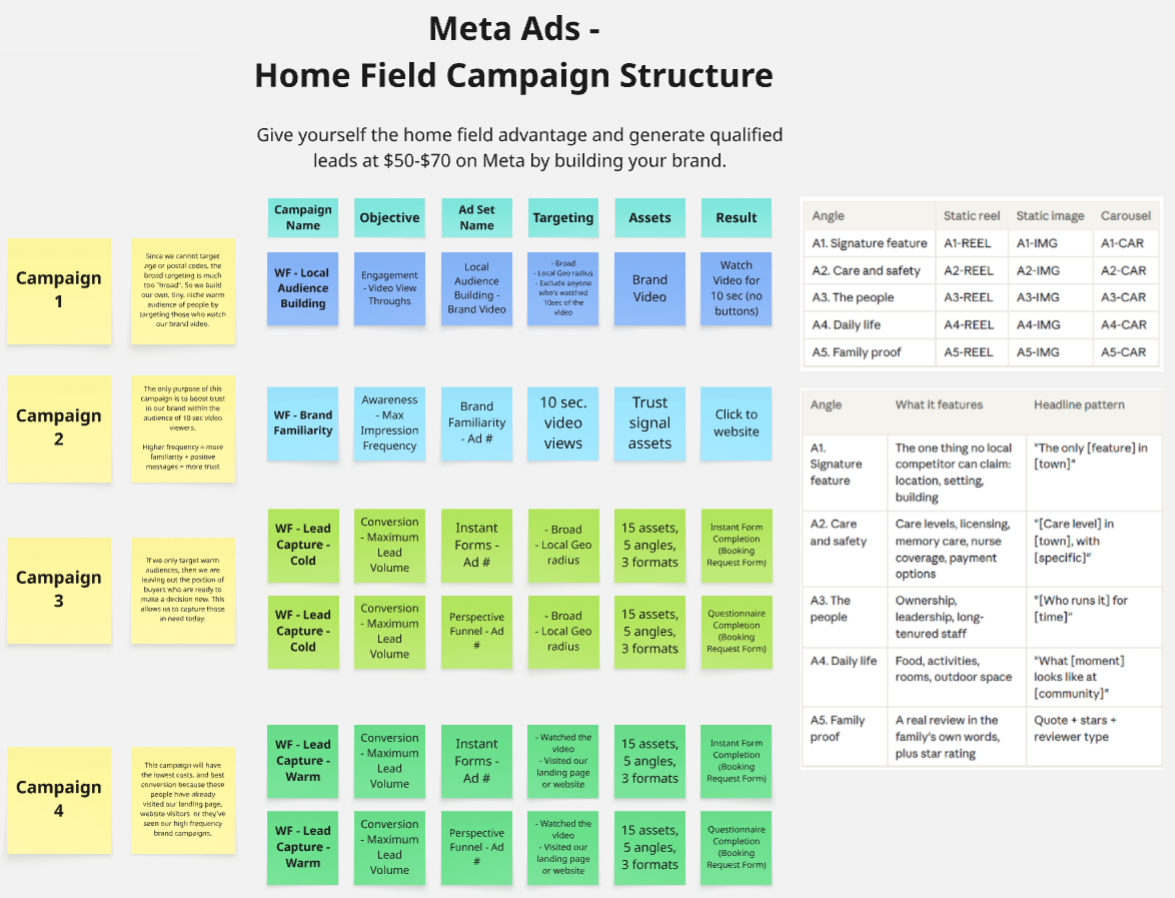
A local senior living community has one advantage that placement agencies and national brands cannot copy: it belongs to the town. The Home Field strategy uses Facebook and Instagram to make the community a name local families already know and trust before they start a serious search. Built this way, it generates qualified leads at $50 to $70 each.
Meta restricts the targeting available for senior living ads. Advertisers cannot target by age or postal code, so a broad local audience includes many people who will never need senior living. Home Field solves this by building its own small, warm audience: local people who chose to watch the community's brand video.
| Campaign | Objective | Who sees it | What it runs | Success |
|---|---|---|---|---|
| 1. Local Audience Building | Engagement, video views | Broad local radius, excluding anyone who has watched 10 seconds | Brand video | A 10-second view |
| 2. Brand Familiarity | Awareness, maximum frequency | 10-second video viewers | Trust signal assets | A click to the website |
| 3. Lead Capture: Cold | Conversions, maximum leads | Broad local radius | 15 assets: 5 angles in 3 formats | A booking request or questionnaire |
| 4. Lead Capture: Warm | Conversions, maximum leads | Video viewers and website visitors | 15 assets: 5 angles in 3 formats | A booking request or questionnaire |
A brand video runs to a broad local audience. Anyone who watches 10 seconds joins the warm audience and is then excluded, so the budget keeps reaching new families.
Trust signals run to the warm audience at maximum frequency: reviews, staff, licensing and life inside the community.
Reaches families who need to decide now, through an instant booking form and a questionnaire funnel.
The same lead formats run to people who already know the community. Lowest cost per lead, best conversion.
| Angle | What it features | Headline pattern |
|---|---|---|
| Signature feature | The one thing no local competitor can claim: location, setting, building | "The only [feature] in [town]" |
| Care and safety | Care levels, licensing, memory care, nurse coverage, payment options | "[Care level] in [town], with [specific]" |
| The people | Ownership, leadership, long-tenured staff | "[Who runs it] for [time]" |
| Daily life | Food, activities, suites, outdoor space | "What [moment] looks like at [community]" |
| Family proof | A real review in the family's own words, with the star rating | Quote, stars and reviewer type |
Every VRS residence had real material for each angle: lakefront settings, long-tenured staff, assisted living care plans, and residents' own words.
Signature feature. Andover Terrace sits on the shore of Shuswap Lake. No competitor in Salmon Arm can claim that setting.
Signature feature. Lakeside Gardens on Long Lake in Nanaimo. Location leads the message.
Care and safety. Shuswap Lodge offers assisted living with personalized care plans. Care-level messaging names what families need to hear.
The people. Real staff with real residents at Ross Place. Families trust the people before the building.
Daily life. The gardens at Orchard Gardens in Kelowna. Daily life creative shows what a normal day looks like.

Lakeside Gardens: Handcrafted meals
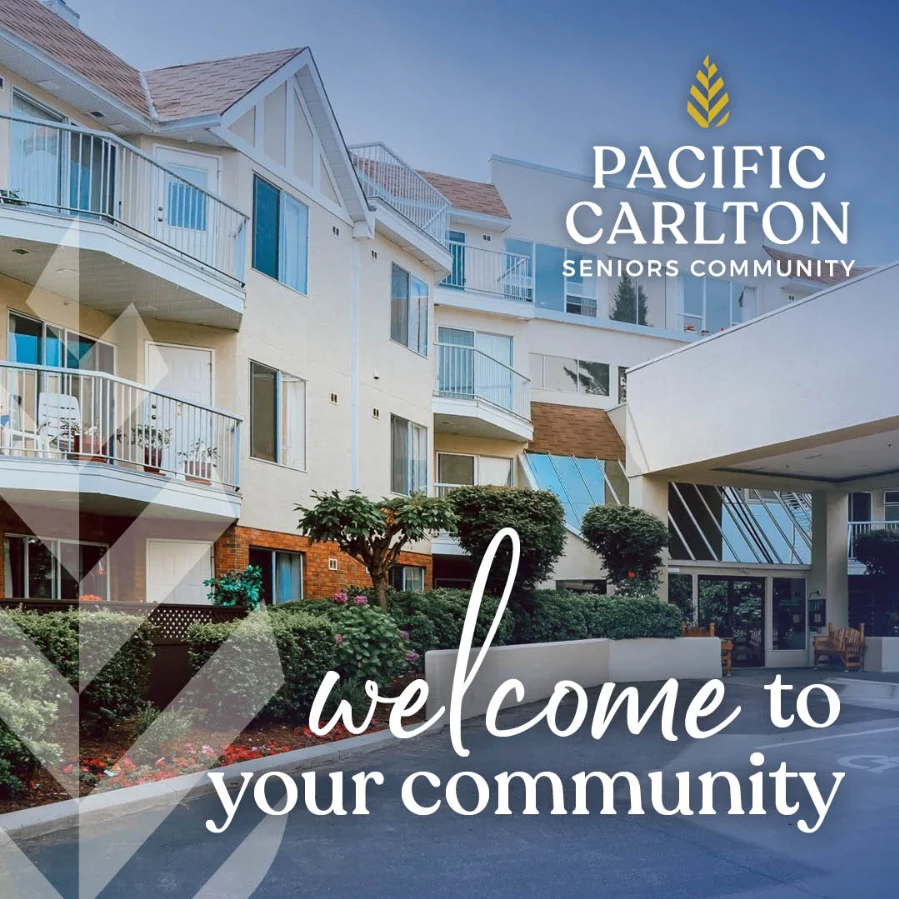
Pacific Carlton: Welcome to your community

VRS Communities: Your best chapter

Pacific Carlton: Meals to share
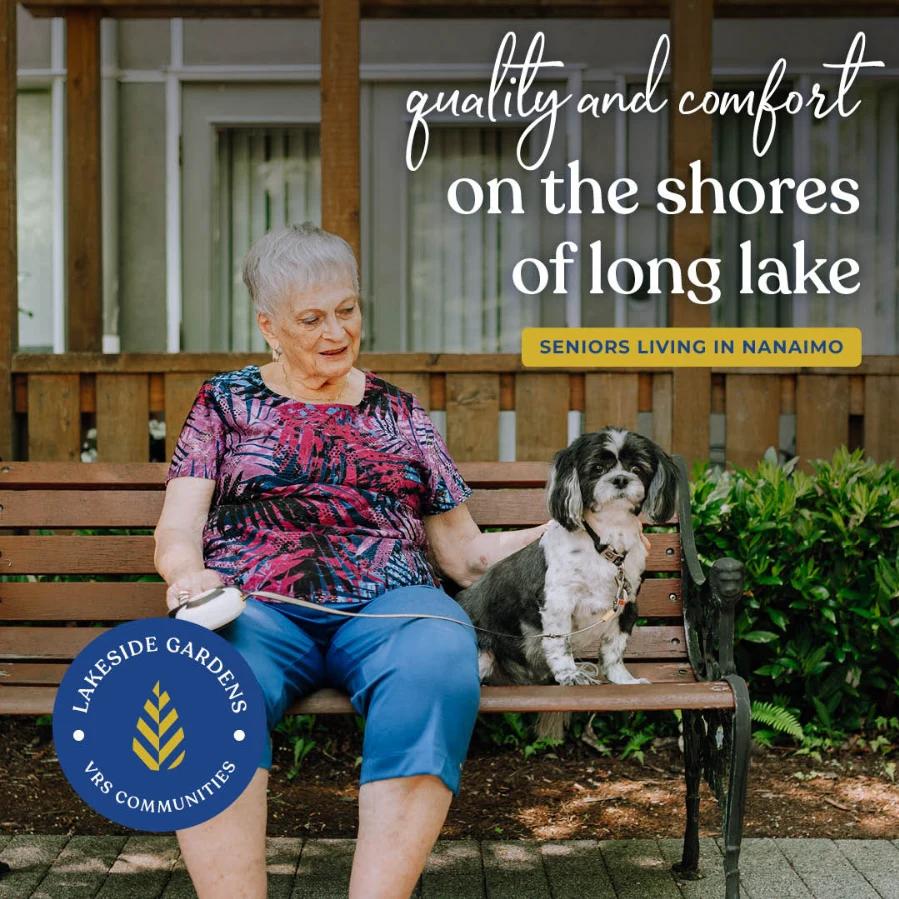
Lakeside Gardens: Life on Long Lake
Most of Meta's effect shows up in other channels. A family watches the brand video, sees the community for weeks, then searches it by name on Google or calls directly. Last-click reporting gives that move-in to Google. We track Meta-sourced and Meta-influenced move-ins separately:
Google Ads
Google Ads captures families who are already searching. Our structure has four layers, and each has a different job. For the wider strategy, see our guide to Google Ads for senior living communities.
A separate, bid-capped campaign protects the community's name. The name is also a negative keyword in every other campaign.
Senior living, independent living, assisted living and memory care, combined with each residence's town and nearby neighbourhoods.
Selected campaigns appear when families search nearby communities by name, so the community is part of the comparison.
Expands reach to relevant searches the keyword list misses, inside the structure above. We do not use Performance Max.
Hygiene from month one. Every account starts with a full negative keyword list covering jobs, careers and hiring. Every conversion is tracked past the first click, through tours and move-ins, so budget moves toward the keywords that fill suites.
We measured return using VRS's own monthly occupancy records.
One system can fill suites across a whole portfolio, including residences that open partway through.
Families take longer and compare more. Long-window Meta content and local search keep the community in view.
Searches often start after a fall or hospital stay. Response speed, map pack visibility and reviews decide the first call.
Families need to trust the care team before they tour. Storytelling featuring staff and daily routines does that work.
The VRS results above cover independent and assisted living residences. For care-specific considerations, see our guide to lead generation for memory care communities.
Over 59 months from February 2021, VRS Communities filled 275 suites across 13 independent and assisted living residences in British Columbia and Alberta, net of residents who moved out. Average occupancy increased by 38.6 percentage points per residence, and marketing returned 3,268%. The partnership is in its sixth year.
Google search campaigns and Google Business Profile improvements reach families who are already searching, so inquiries can start within weeks. Meta brand campaigns and local search visibility build on that and lower the cost of each move-in over time. VRS saw move-ins from the first year of the partnership.
Every residence loses residents each year as their health changes or they move to a higher level of care. The more suites a community or portfolio has, the more move-outs it sees in a normal year. Larger operators need a steady flow of move-ins just to hold occupancy level, so marketing has to run all year.
Yes. The system is the same across care types, while messaging, channels and speed of follow-up change with the urgency of the decision. Assisted living and memory care decisions often move faster after a health event. Independent living decisions usually take longer and involve more comparison.
Home Field is Wisdom First's four-campaign Meta structure for senior living communities. A brand video builds a warm audience of local people who watched for 10 seconds. High-frequency trust content keeps the community familiar to them. Lead campaigns then reach cold and warm local audiences with booking forms and questionnaires, at $50 to $70 per qualified lead.
Occupancy at each residence in February 2021 set the baseline. Occupied suites above that baseline were multiplied by each residence's average monthly rate and added up month by month. Two residences that opened during the partnership were counted from their first month. Marketing investment was subtracted from that revenue, then divided by the investment.
Yes. Placement agencies are useful referral partners, and they typically charge around one month's rent per move-in. A community that builds its own local brand, search presence and follow-up system generates more of its own inquiries, which lowers the average cost of each move-in over time.
Start with a Trust Funnel Audit. It reviews your local competitors, reviews, website, ads and AI search visibility, and shows where families find you and where they drop off.
Ready to talk? Choose a time below to book directly with our team.
Book directly on Calendly